By Isabel Dawson, Policy Associate
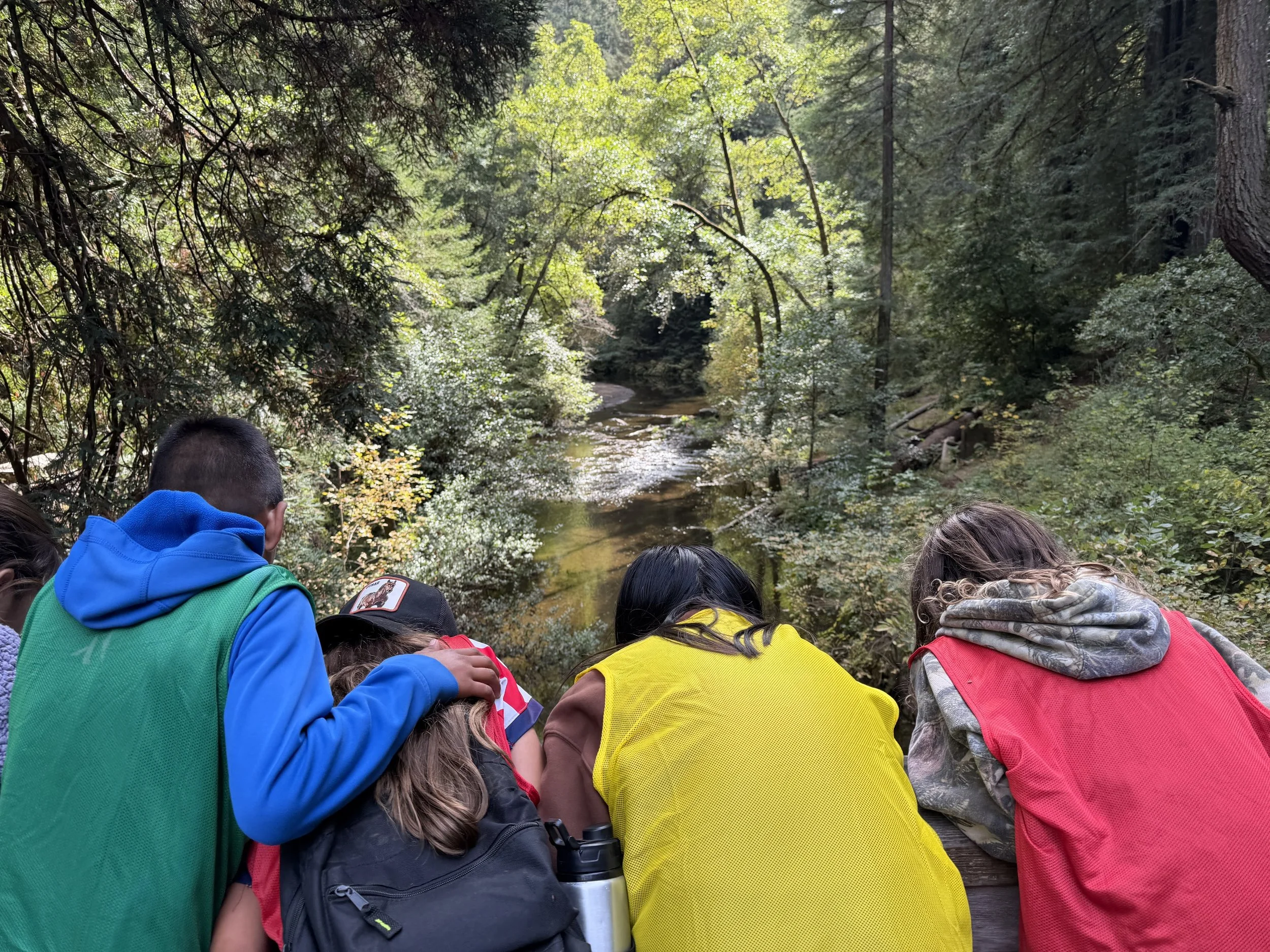
Last month, we were pleased to offer two field trips to elementary and middle school students from West Marin School and Tomales Elementary School.
Guided by EAC staff and naturalists, students explored the redwood forests and riparian ecosystems of Samuel P. Taylor State Park, learning about redwood function and structure, the salmon life cycle, and different plants and animals that could be found along the trail, like sword ferns, Pacific trillium, banana slugs, and acorn woodpeckers.
Students had the chance to connect with the environment through all their senses—listening for scrub jay calls, feeling the cool water of Lagunitas Creek, smelling the fragrant leaves of the California Bay Laurel, and looking up at the towering canopy of the Coast Redwood.
Many students had not been to the park before, and we were delighted to bring them on the Pioneer trail for the first time. Students filled out activity journals, developed by a former Coastal Advocate intern, contemplating the importance of redwood trees as a keystone species, drawing forest zones, and recording their own naturalist notes.
Students shared they had learned about how redwood forests support a vast ecosystem of plants and animals and serve as natural “air purifiers”, and retain water in the ecosystem. They also were excited to do leaf rubbings at the creek, play interactive games under the trees, and do sensory grounding in the forest. One student said that his body and mind felt calmer in Samuel P. Taylor than he ever did at school—and we agree, redwoods are the best nervous system regulator!
But our field trip program is facing a funding gap next year. We consistently receive positive feedback from students and their schools about their field trip experience, and we don’t want to cut this vital program. We would love to continue offering these experiences for local and underserved school children to learn how the ecosystems they live in benefit all of us. Help us do that by donating today—$100 allows us to provide materials for one school’s field trip, $350 covers bus expenses for one trip for our students to reach local wilderness areas, and $2,000 allows us to host one field trip for a large school group, including hiring bilingual, professional naturalists to help us guide students in small activity groups.
Learn More
Donate Today
Environmental Education at EAC
Vote for us in the 2026 Nonprofit Insurance Alliance Photo Contest by 11/20!